Tips and Tricks

DOES YOUR BABY HAVE A FLAT HEAD?

Many parents have the feeling that their baby fell asleep with the most perfectly round head, only to wake up the next morning and discover that their baby's head is no longer perfectly round, but slightly flat on one side. This can cause concern, but it is actually very common; it does not, of course, happen overnight, but rather creeps up gradually. Other babies have been compressed while inside their mother's womb, or they were delivered using a vacuum extractor, so their heads are misshapen from birth, which can lead to uncertainty about whether the head will ever correct itself.

So what is a misshapen head? What should you look out for, and how can you gently support your baby based on research and clinical practice to influence your baby's head shape? We will look at this in this post.

May 14, 2026

Didde Darling Thorsted

Didde Darling Thorsted

This post was written in collaboration with Didde Darling Thorsted from Q Klinik, specializing in baby & child treatment, Auth. Osteopath DO, M.R.O. DK, PG Cert Paed & DPO, Auth. Physiotherapist & Naturopath.

Why do some babies develop a flat spot on the back of their head?

In the vast majority of cases, this is what is known as positional skull deformity (plagiocephaly), which most often occurs when the child's head is influenced by unilateral pressure and positioning over time, or by tension and tightness in the muscles and fascia (the body's connective tissue) that connect the body and head.

A baby's skull is incredibly soft and malleable, which is completely natural so that the baby's head can pass through the birth canal. Subsequently, it is an important part of early development, where the brain develops at a rapid pace and needs plenty of room and flexibility in the skull for corresponding brain growth. However, this also means that the head shape can change depending on how the child lies and moves.

Often there is not one single cause, but rather a combination of several factors:

  • That the baby has a preference for looking to one side.
  • Tension in the neck or body.
  • Less variation in positions during the day.  
  • That the baby spends a lot of time on their back in the same position.
  • That the baby was born prematurely.

What should you be aware of?

Many parents are very concerned about whether their baby has or is developing a flat spot on the back of their head. Many invest in expensive apps to monitor their child's skull development, but you can easily detect it yourself if you look for the following signs.

<p>Signs of a flat head can include:</p>

Signs of a flat head can include:

  • That the baby often looks to the same side  
  • That the baby often sleeps with their head turned to the same side 
  • That the baby is easiest to carry in the same position, or on the same arm
  • That during tummy time, the baby only or mostly looks, tilts, or rolls to one side
  • That the baby becomes restless, cries, or resists when their head is turned to the other side. 
  • That the baby quickly turns back to the same side after you have turned their head
  • That the baby consistently "chooses" to look away from the side where you are enticing them with light, sound, and toys   
  • Asymmetry in the back of the head 
  • Uneven ear position
  • Slight asymmetry in the face; one eye may appear larger than the other, or the forehead may bulge on one side  

Can I test my baby myself?

In addition to watching for signs, you can gently turn your baby's head when they are in a deep sleep to feel if there is any resistance to the movement, even while the child is sleeping. When the child is awake, you can try to actively entice the baby from side to side by talking to the little one and stroking their cheek, first from one side, then the other.

You can also do the following, take a picture of your baby:

  • From above: so you can see if the baby's head is straight from the top behind on both sides, if the ears are aligned, and if the forehead protrudes equally. You can optionally place your index fingers next to the ear canals when the photo is taken, as a small baby's ears can be difficult to see in the picture.
  • From the sides: so you can see if the shape from the side is the same on both sides
  • From below: so you can see if the baby's cheeks and forehead protrude equally (this one can be a bit difficult)

If your baby is a newborn, it can be done at one-week intervals; if your baby is older, it can be done once a month (perhaps while the baby is sleeping)

5 quick tips: what can you do yourself?

1. Create variation in everyday life

  • Switch sides when carrying your child
  • Vary positions throughout the day
  • When picking up your child, roll the little one onto their side and lift them from there. Remember to do this from both the right and left sides.  

2. Limit unilateral positions

Let your baby sit as little as possible in a car seat, bouncer, or other baby equipment where the little one cannot move freely and is resting on the back of their head.

3. Prioritize floor time and tummy time with high quality and joy

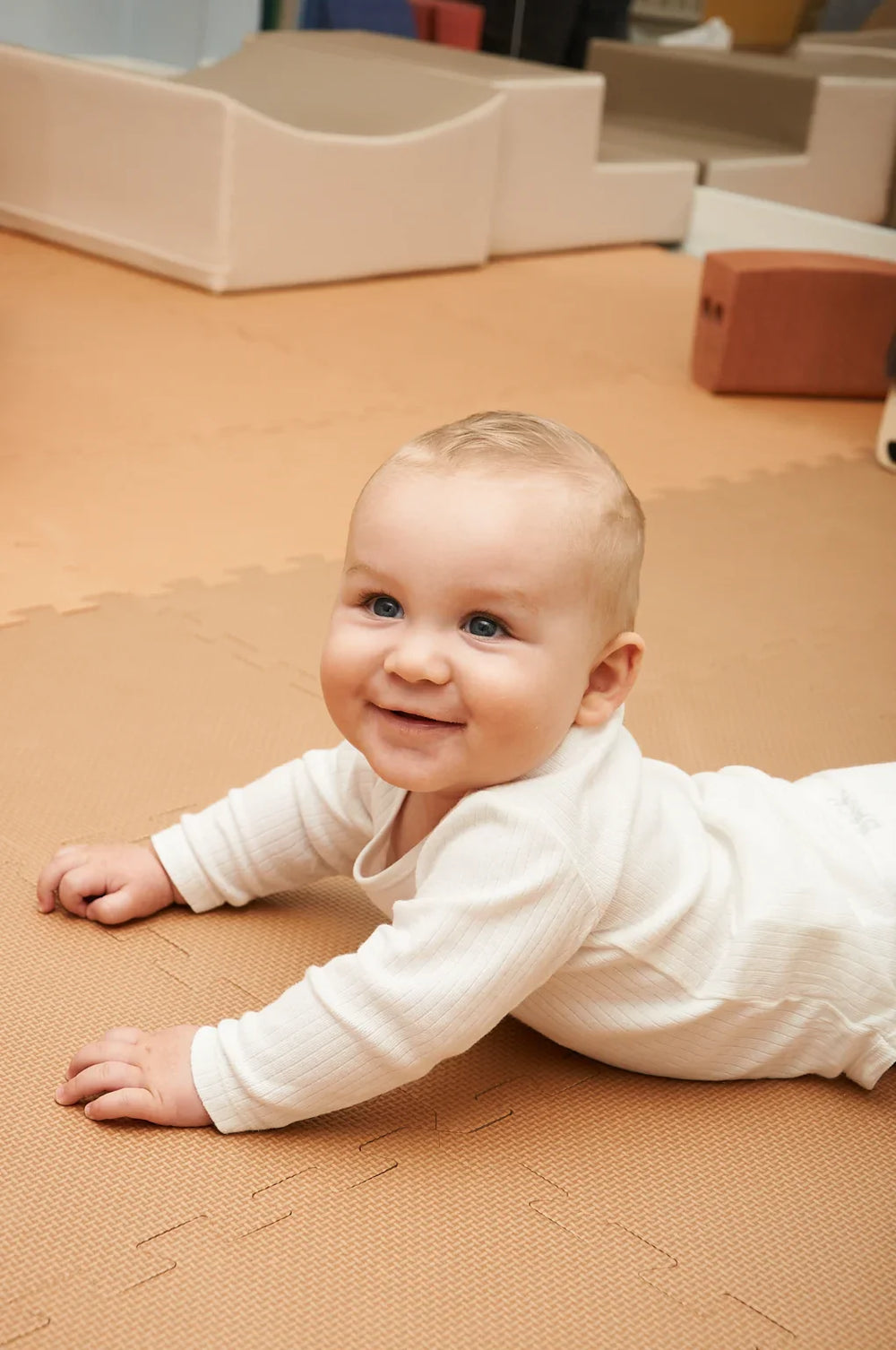
Daily tummy time strengthens your child's body and motor development, and relieves pressure on the back of the head. Just remember to help your little one lie and look to both sides while they are very small. When the baby is older and can focus on your face or a toy, you can actively entice them to look to both sides.

Time on the floor gives the child the opportunity for free movement. If you have a very cold floor, get an insulating mat and place your little one in a corner of the room to avoid drafts, if possible.

If your child is not very fond of tummy time, do it frequently and in short intervals. Try rolling your baby onto their stomach at every nappy change, first over the right side, then the left. Lay your child on their stomach on your legs or on your forearm, or let the baby practice tummy time on your chest. Remember that anything is better than nothing. See what works best for you. If necessary, get training tips from your pediatric physiotherapist, osteopath, or chiropractor.

4. Encourage activity from both sides

 Talk, play and place toys on the side that your child does not automatically choose.

5. Change side

Whether breastfeeding or bottle-feeding, this also provides natural variation in movement patterns, so the pressure and pull on the child's skull are varied. 

When does it make sense to seek help?

  • If the head shape is misshapen from birth and does not change noticeably over the first 2-4 weeks
  • If the head shape becomes more misshapen over time
  • If your child clearly or exclusively prefers one side
  • If, despite your own efforts, you cannot get your baby to freely turn their head to both sides
  • If your baby becomes upset or appears uncomfortable when you turn their head.

Then it may be relevant to have it assessed by a manual therapist with experience and training in treating children.

How can manual therapy help?

The purpose of the treatment is to ensure the baby's freedom of movement so that the skull is relieved of unilateral pressure and tension. By ensuring optimal movement, the baby's body and skull are given the opportunity to develop symmetry, which increases the head's ability to correct itself and grow more uniformly. Manual therapists offer gentle treatment, adapted to the individual child, and provide you with concrete tools for everyday life if you feel that your own efforts are not enough.  

<p><strong>An important point</strong></p>

An important point

Recent research shows that a flat head (positional plagiocephaly) is a common condition in infancy, and that early intervention with variation in positions and movement can have a positive effect on skull shape and function.

It is not your fault that your child has an asymmetrical head. A flat head is in most cases harmless and temporary – and small changes in everyday life can make a big difference over time.