Tips and Tricks

When can a baby roll over, turn, and sit up on their own?

Guide to three major motor milestones

When can a baby roll from tummy to back, from back to tummy, and sit up on their own? Get an overview of these important motor milestones and helpful tips for supporting your child's development.

August 24, 2026

Didde Darling Thorsted

Didde Darling Thorsted

This post was written in collaboration with Didde Darling Thorsted from Q Klinik, specializing in baby & child treatment, Registered Osteopath DO, M.R.O. DK, PG Cert Paed & DPO, Registered Physiotherapist & Naturopath.

Small movements that turn into big milestones

The first smile. The first laugh. The first time your baby rolls onto their tummy.

Almost overnight, new skills appear. Suddenly, your baby can lift their head a little higher, reach for their toys, or roll onto their tummy. There is something truly special about these little moments that make us reach for our phones to take a picture or send a message to the grandparents.

At the same time, it is also a period when many questions naturally arise:

"Should my baby be able to roll from back to tummy by now?"

"When can a baby roll from back to tummy?"

"Is it normal that she isn't sitting up on her own yet?"

If you have had these thoughts, you are definitely not alone.

Almost every parent, at some point, compares their baby's development either with other children's or with an app featuring little developmental milestones. But the truth is that babies rarely follow a specific schedule, as every child develops at their own pace. 

There is no single right age

When we talk about motor development, such as when a child should learn to roll over, sit up, or crawl, it is important to remember that all children are different. You may have heard that a baby "should" be able to do something specific by four months of age, but fortunately, reality is more nuanced. Motor development is not a competition, and healthy children can easily develop at different rates without there being any cause for concern.

New research shows that an infant's motor development is influenced by many things. The child's muscles, nervous system, temperament, opportunities for free movement, and experiences exploring their body all play a role.

Some children love lying on their stomachs from the very first day. Others need a little more time to get used to it. Some roll over early, while others use their energy practicing babbling, grasping, kicking, or investigating their world in other ways.

The most important thing is therefore not the exact date, but that your child is gradually becoming stronger, more curious, and eager to move. For this reason, motor milestones are best viewed as indicative markers rather than fixed deadlines.

<p>Motor skills are built on top of each other</p>

Motor skills are built on top of each other

When we see a baby roll over for the first time, it can look accidental and seem as if it happens overnight. But behind that small movement lies weeks of development.

Every time your baby lifts their head during tummy time, kicks their legs, or turns towards your voice, your baby is training their body and the brain is constantly learning something new. It registers how the body moves, how the weight shifts from one side to the other, and how the body is held stable while the head, arms, and legs work together.

All those small experiences are eventually gathered into one major skill. This is why motor development is described as a chain of small steps, where each step builds on the previous one, like building a house where you start with the foundation and only after that can the next floor be built. This is also why a baby cannot learn to sit up on their own until the body has developed the strength and balance that makes it possible.

<p>When can a baby roll from back to stomach?</p>

When can a baby roll from back to stomach?

Most babies learn to roll from their back to their stomach between 4 and 6 months. Here, the child must initiate the movement themselves and perform an important motor skill. For this to succeed, many things must work together. The child must be able to turn their head, reach out for something exciting, lift their legs, shift their weight to one side, and use the abdominal muscles to pull themselves forward, rotate, and laterally flex the body.

It may sound simple, but it is actually one of the most advanced motor skills in the first few months. Therefore, it is perfectly normal for the child to practice for a long time. The baby’s core becomes strong enough that head movement can be controlled first, then the arms and legs come up into the air. The little one rocks from side to side like a "little beetle on its shell" before they learn to tip onto their side, and gradually it becomes more controlled. The baby then starts to get better at crossing the body's midline and twisting the body like a screw. Once the baby masters lying on their side and can also lift themselves sideways, the entire movement succeeds. Motor development rarely happens in big leaps. It consists of many small steps that together become a new skill.

When can a baby roll from tummy to back?

Many parents find that their baby rolls from tummy to back early on, only to suddenly stop doing it. This can happen as early as 3-4 months of age. In these cases, the movement is often not intentional. The little one is helped along by gravity because the baby does not yet lie stably on their tummy. When the baby lies on their tummy and lifts their head high, their weight automatically shifts slightly to one side; if the balance tips enough, the rest of the body follows, and suddenly the child is on their back. It can come as quite a surprise. Many parents find that they turn their backs for a brief moment, and when they look back, the baby has suddenly landed on their back. 

Some babies discover that their body can do something new and begin to experiment with doing it again, so the movement gradually becomes more deliberate. 

The vast majority of babies only roll in a controlled manner from tummy to back when they are active and able to shift their weight, rotate their upper body, and control the movement, rather than just "falling" onto their backs. Training for the controlled roll from tummy to back often begins at a developmental age of 5-6 months and is only perfected at 7-8 months. 

Why is it so important for a baby to learn to roll over?

When a baby learns to turn over or roll, it is about much more than just being able to get from one side to the other. When your baby rolls, their body is training many things at once. The little one learns to shift weight from side to side, coordinate arms and legs, use the muscles around the stomach, back, and hips, as well as rotate the body. These are all fundamental movements that we will use for the rest of our lives. At the same time, balance improves, and the brain practices controlling the body in new directions. It is precisely these super important bodily experiences that later make it easier to:

  • Sit up
  • Crawl
  • Stand up
  • Walk
  • Run

Being able to roll is, therefore, a foundation for many of the motor milestones that come later, so rolling is more than just a fun movement.

What if my baby only rolls to one side?

It is perfectly normal for babies to have a favorite direction for a short period. Perhaps your baby turns more easily to one side, or feels more motivated by the surroundings on one side. This is usually not a problem if your child also begins to show an interest in moving towards the other side within a short time.

However, if your child always chooses the same side, seems uncomfortable looking the other way, or has difficulty turning their head freely, it may be a good idea to pay attention. This can be a sign that there is tension in the baby's body, which affects the little one's freedom of movement and can lead to a locked movement pattern.

This can easily be helped along with exercises and, in some cases, a little treatment. The earlier a clear asymmetry is discovered, the easier it often is to support the child in using their body more symmetrically.

When can a baby sit up on their own?

A baby being able to sit up on their own is a milestone that many parents look forward to. Suddenly, the child can join in at the dining table and experience the world from a whole new angle. Most babies can sit without support between 6 and 9 months. But the road to getting there begins long before.

To be able to sit, a baby must first learn to hold their head steady, find their balance, and strengthen the muscles around the back, abdomen, and pelvis. This does not happen overnight. It develops through all the small movements the child has practiced since birth.

Should you help your baby sit up?

It can be tempting to prop your baby up with pillows around them. Perhaps the child looks curious and seems ready to join in. However, we recommend that the child works their way toward a sitting position on their own as much as possible and learns to sit up by themselves.

When a baby finds their balance on their own, the body learns exactly how the muscles need to work together. If the child loses their balance and tips over to the side, it is actually part of the learning process. The brain registers what happened and uses that experience next time. 

This does not mean that you should never have your baby sitting on your lap, as closeness and interaction are of course very important, but when it comes to motor development, free movement on the floor is the best exercise your baby can get.

What can you do yourself at home?

Tummy time - the small effort with the big impact

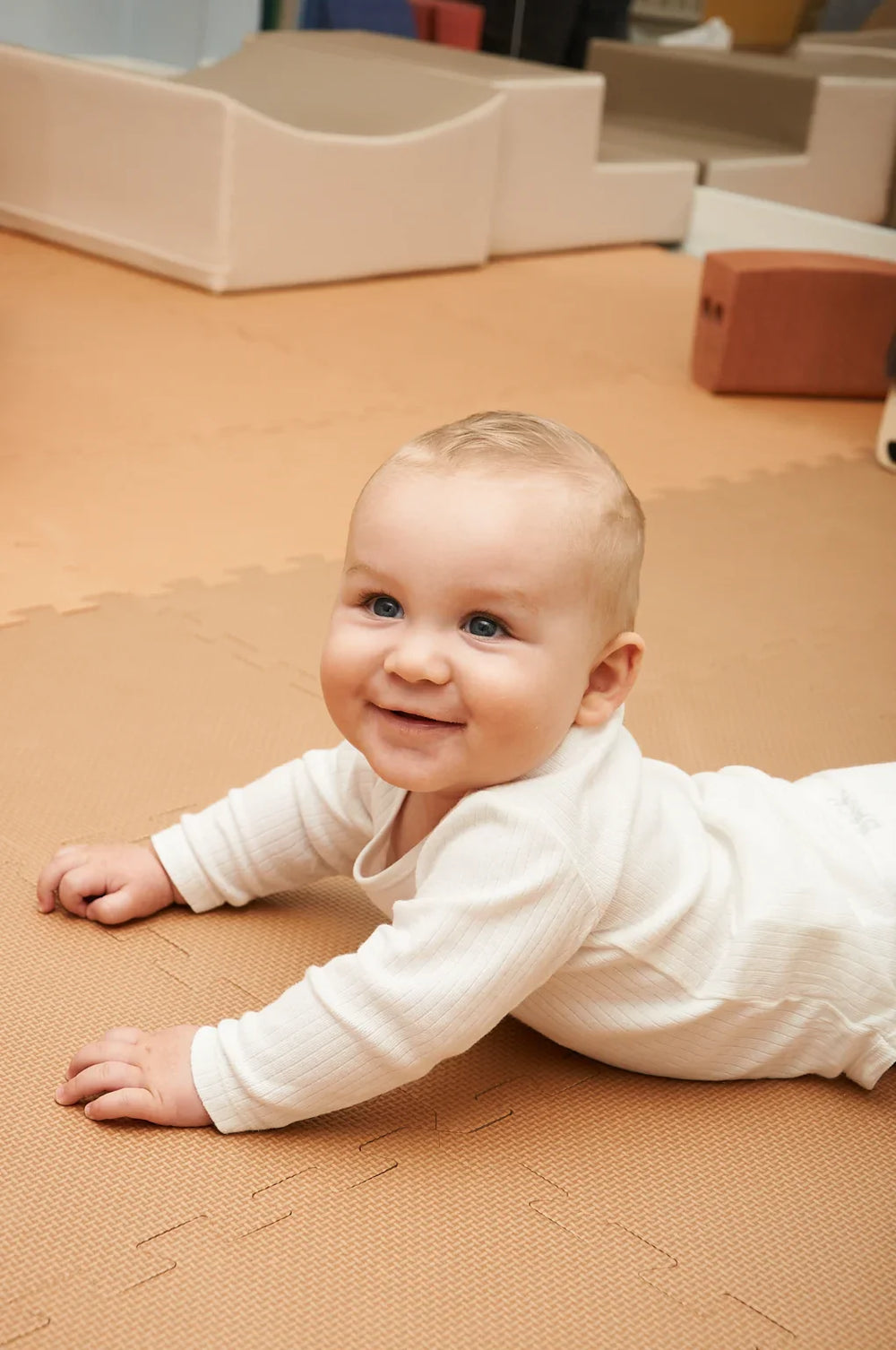
Many parents have heard about tummy time, and there is a good reason why everyone keeps talking about it, because when your baby lies on their stomach, the muscles in the neck, shoulders, back, and abdomen are strengthened. At the same time, the child learns to support themselves on their arms, shift their weight, and lift their body, which is so important when the child is to turn over, roll, sit, and crawl.

We often find that many babies are not keen on tummy time at first. Start with just a few minutes at a time and repeat many times throughout the day. Lay the child on your chest, sing a song, or place a mirror in front of them so there is something exciting to look at. Small moments of success several times a day often make a bigger difference than one long session.

How you can support your baby's free movement

Today, many babies spend a fair amount of time in car seats, bouncers, prams, and other aids. They may be convenient in everyday life, but they cannot replace free movement on the floor. When your baby lies on a firm surface, their body has the opportunity to work quite naturally. The little one can kick their legs, reach for toys, turn their head, and experiment with new movements. It is precisely through these small attempts that the body learns. You could therefore say that the floor is your child's first playground and, at the same time, the place where some of the most important motor skills are developed.

You do not need any special toys, specific equipment, or advanced exercises to support your child's motor development. One of the best things you can do is give your baby time to explore their body.

  • Be aware that clothing can limit the child's ability to move freely.
  • Give your baby time and space to move.
  • Let the child lie on a firm surface every day. This could be on a play mat on the floor, where there is room to kick, turn, reach out, and explore the body at their own pace.
  • Alternate between back, tummy, and side positions.
  • Place a toy slightly to the side so that the child feels encouraged to turn their head and body to follow it.
  • Talk to your child from different angles.
  • Switch sides when you talk to the child or present toys, so that both sides of the body are used.

Most importantly, allow space for the child to find the solutions themselves. It is through curiosity and play that the greatest progress occurs.

When should one seek advice?

All children develop differently. Therefore, it is rarely the exact age that determines whether there is cause for concern. The most important thing is that development is moving forward. You may benefit from talking to your health visitor or a licensed manual therapist specializing in babies if you notice that your child:

  • Always turns their head to the same side
  • Seems very stiff or very floppy
  • Uses one side of their body significantly less than the other
  • Shows no interest in moving
  • Does not try to roll over by around 7-8 months
  • Is not close to being able to sit up on their own by around 9 months

It often turns out that the child is simply following their own pace. At other times, simple advice or exercises can make a big difference and give you peace of mind. Remember that your child is following their own path.

It is completely natural to look forward to the first milestones, and it can also be hard not to compare. Perhaps a child in your parent group is already walking around the coffee table, while your own baby is still practicing rolling over. This does not necessarily mean that anything is wrong. Children learn in different sequences. Some spend a long time practicing rolling and sitting up. The most important thing is that your child is allowed to develop at their own pace. With time, free movement, presence, and lots of play, the body gets the best conditions to become strong.

<p>Brief summary</p>

Brief summary

If you only remember one thing, let it be this:

Motor development is not a race.

Most babies:

  • Roll from back to tummy around 4-7 months
  • Roll in a controlled manner from tummy to back around 6-8 months
  • Sit up on their own between 6 and 9 months

There is great variation, and healthy children develop at different paces.

The most important thing is not when a specific milestone is reached, but that your child gradually becomes stronger, more curious, and gets the opportunity to explore the world through movement.

And remember – if you have any doubts about your child's motor development, it is always a good idea to ask. A professional assessment can provide answers, peace of mind, and practical advice, so you can confidently follow your child's further development.