Latest Mom Diary

Johanne Landbo

On losing faith – and slowly finding it again

When Johanne Landbo lay on the operating table at the hospital in Thisted and heard her daughter cry for the first time, she asked the nurse if they had put morphine in her IV. She felt so good that it couldn't be right. But it wasn't medication. It was her own happy hormones – and a sense of peace she hadn't felt in years. "No, those are just your own happy hormones." Behind that moment lie six years of fertility treatment, two egg donations, a journey through biochemical pregnancies, a miscarriage, an immunology expert, 300,000 kroner, countless bus trips across the Great Belt – and a woman from Instagram who came cycling along in a blue dress with a nose ring and changed everything. It is a story about losing one's naivety and yet holding on to the joy of life. And about the fact that you can be strong and broken at the same time.

September 30, 2026

Latest Mom Diary

Johanne Landbo

On losing faith – and slowly finding it again

September 30, 2026

When Johanne Landbo lay on the operating table at the hospital in Thisted and heard her daughter cry for the first time, she asked the nurse if they had put morphine in her IV. She felt so good that it couldn't be right. But it wasn't medication. It was her own happy hormones – and a sense of peace she hadn't felt in years. "No, those are just your own happy hormones." Behind that moment lie six years of fertility treatment, two egg donations, a journey through biochemical pregnancies, a miscarriage, an immunology expert, 300,000 kroner, countless bus trips across the Great Belt – and a woman from Instagram who came cycling along in a blue dress with a nose ring and changed everything. It is a story about losing one's naivety and yet holding on to the joy of life. And about the fact that you can be strong and broken at the same time.
Image 1

From photoshoots to fertility clinic

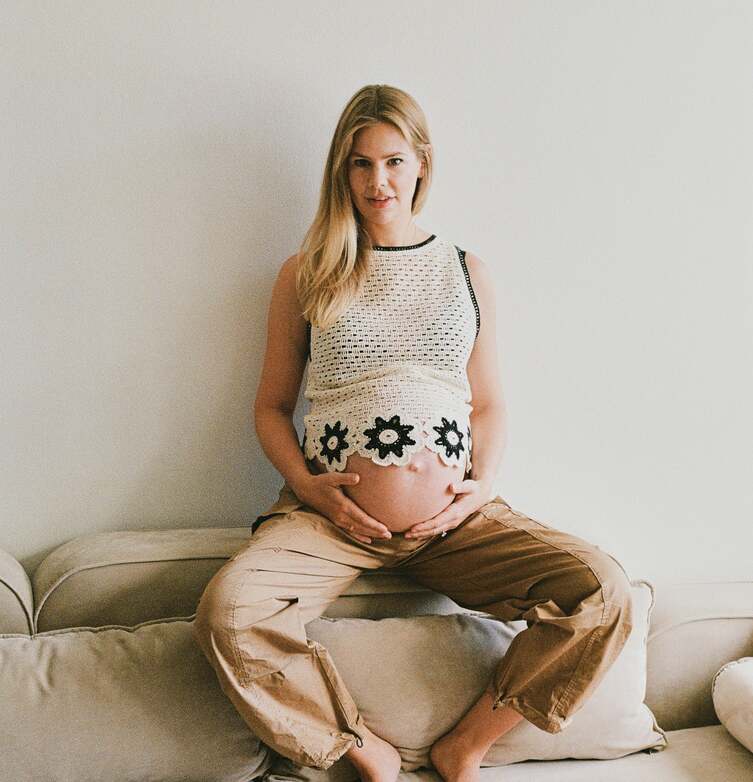
Johanne is 32 years old, a content creator and influencer living in Thy with her husband Lukas, who is a photographer and works at Elsk in Thisted. Together, they have six-year-old Magda and little sister Roberta, who is five weeks corrected.

Johanne and Lukas met in Aarhus when they were 22 – "before Tinder," as she puts it. He was playing football for AGF, and she was working as a model and traveling the world. Two lifestyles that were difficult to reconcile. Even so, things moved quickly, and they soon bought an apartment on the fifth floor on Grønnegade in Aarhus. That was where Johanne started the profile that many follow today – which is why it is called Femte til venstre.

They weren't talking about children yet. But Lukas knew there could be challenges because he was born with a condition that could affect his sperm quality. So, at 23, they went in to get checked to see where they stood. They hadn't even started trying yet.

Image 2

At their first consultation at the fertility clinic, they received news they hadn't seen coming. It wasn't Lukas who was the biggest challenge. It was Johanne. Her AMH level, which indicates how many eggs one has left, was very low for a 23-year-old.

"And it came as a huge shock that we were suddenly told: You need to get started. You need to hurry."

For a young couple with their whole lives ahead of them, it meant having to turn their lives upside down overnight.

"I was really sad, because I knew full well what it entailed. And to have to make that decision at such a young age. We had our whole lives ahead of us. Lukas, who plays football, and me, who travels. It was suddenly a matter of having to reorganize our whole lives for it."

Image 1

To put one's own genes on the shelf

They started ICSI treatment, and Johanne went through four egg retrievals. The eggs were fertilized, but they did not develop. Egg donation was mentioned quite quickly – and that hit a particularly sore spot for her.

"It’s hard when you live in a world where you make a living from your appearance. I mean, that thing about having to shelve your own genes. That it became so superficial."

Suddenly, she found herself holding what felt like a catalog. Height, weight, eye color – and medical records with information about the donor’s family.

"How do you choose a person based on height, build, and eye color? Do you want freckles? Do you not want freckles? When you meet another person, you don't take those things into consideration."

Image 2

That is why Johanne and Lukas chose to let the clinic make the choice for them. They had photos taken of themselves, and the clinic matched facial shape, eye color, and eye shape so that the child would have something recognizable. The couple still lived in Aarhus, but the treatment took place through a clinic in Copenhagen that collaborated with a large international fertility clinic in Barcelona. The eggs were donated and fertilized in Barcelona, and the collaboration provided a much wider selection of donors than is available in Denmark.

"It was just nice at the time that it didn't have to be my focus. That I could just focus on achieving pregnancy, and then there were people I trusted who were capable of choosing. I think it was too big a responsibility."

<p>Tears and soda cans on Santorini</p>

Tears and soda cans on Santorini

Along the way, the couple took a break from the treatment and from Aarhus, travelling to New York where Johanne was working. Lukas quit his job at AGF and travelled with her. They travelled together – and flew home for treatment in between.

When the results of the first round of egg donation were due, they were in Santorini, where Johanne was working for a client. Lukas asked her to wait to open the email until she was off the clock. But she was sure that it would be fine. It was egg donation, after all.

There was one egg that had developed into a blastocyst. Only one.

"And I cry. I cry so much, and they mustn't know at work. I cried all my makeup off, and I had to lie there with two soda cans on my eyes because I was afraid they would find out."

When she returned to the set, the makeup artist got angry, thinking Johanne had been lying in the sun and had sunstroke – her whole face was red. It was hard to carry so much alone, in a working life without a permanent workplace and colleagues to lean on.

"It was so strange having to keep it a secret, because you can't just blurt it out to every single customer you meet. But the pictures turned out well."

One egg became Magda. Two years after they had started fertility treatment, Johanne became pregnant, and in August 2020, in the middle of the coronavirus pandemic, Magda came into the world. Johanne was 26 years old, and the family had now moved to Copenhagen.

The pregnancy was problem-free.

"I can't make them myself, but I'm good at carrying them. I loved being pregnant. When you've wished for something for so long, you also cherish it a bit more. And I dared to believe in it, too. I hadn't experienced pregnancy loss at that point."

Shortly after, Johanne asked the clinic if the donor could donate again, so they could have eggs on ice for a biological sibling. But the donor had already donated six times, which is the maximum.

"Lukas and I looked at each other and were like: Okay, but since we're a rainbow family anyway, it really doesn't matter. Genes are genes. We're all just people. And they are love children regardless."

<p>Two suitcases and a baby carrier</p>

Two suitcases and a baby carrier

The family lived in Nordvest in Copenhagen, but Johanne never really settled in. When Magda was a year and a half old, they sat in a café in Copenhagen—the place where they always made the big decisions—and asked themselves what they really had to lose. Lukas was on parental leave, and both could work remotely. He had started taking photographs.

So they sold everything they owned and moved into 50 square meters in Barcelona with two suitcases and Magda in a baby carrier.

"Four plates, a cutting board, and a knife. It was the greatest feeling of freedom. When you've been through something that was so intense and confining, and you were sitting in a place where you didn't feel at home, it's just so amazing to get up to the top of Barcelona. It was as if everything lifted from our shoulders."

Life was simple: the beach every day, low expenses, and a child who was home most of the time. But after a year, the longing for social interaction began to pull at them.

"When you have a two-year-old, she doesn't really form a relationship with her grandparents when they only see each other once every four months."

Image 1

Home to Thy

Johanne grew up in Sjørring in Thy, and she had been keeping an eye on the housing market for a long time. If she were to move back home, it wouldn't be to the town she came from, but out by the fjord or the sea. There wasn't much for sale in the area they were looking at, but when a house on the street she dreamed of came up for sale for the first time in ten years, she saw it over FaceTime while her father walked around in it. It had to be their house.

"I had a bit of a knot in my stomach when we signed, because we signed, and then we were like: What are we going to do? What are we going to work with? But my mom and dad are there, and it will be fine. It was with a bit of a shaking hand that we signed."

The house was a renovation project, and it turned out to be bigger than they had expected. The budget ran out, and the gable had to be left open for a while. But it was a new chapter, and a good friend lived only 200 meters away. The two even joked about having their second child at the same time, so they could be on maternity leave together.

"I thought I had found the solution to having a second child. I thought it was egg donation, because it worked the first time. It's good to have a naive approach until it suddenly hits you."

Image 2
<p>Four eggs in the freezer</p>

Four eggs in the freezer

Johanne and Lukas waited to get started until the renovation was finished. They didn't want to mix the two. When Magda was three, the time had come. The same clinic in Copenhagen and Barcelona, the same method, the same way of choosing a donor. The first donation yielded no fertilized eggs, but they were offered a new round for free, and after a trip to Barcelona, where Lukas provided a fresh sample, there were four blastocysts in the freezer.

"We were just like: Cheers! And there were even enough for three children. Again, that naive approach – it really takes me a long way in some areas."

But now they lived in Thy, and the embryo transfers took place in Copenhagen. Before each transfer, Johanne had to go for scans and preliminary examinations. She would leave home at four in the morning, park in Aarhus, and take the six o'clock bus all the way to Copenhagen. The scan took five minutes. Then it was the trip back home again. She had to do that two to three times per attempt.

The first attempt was unsuccessful. The second attempt resulted in a biochemical pregnancy, where the egg attaches, but the pregnancy never really gets started.

"It's that situation where you can just barely see two faint lines on the test, and then they slowly fade away again."

Before the third attempt, she had external scans done at a clinic in Central Jutland and a hysteroscopy to examine her uterus. Everything looked normal. Then the last egg was transferred, and Johanne became pregnant.

"And I was just like: Of course it had to be the last one. Perfect. Then we're done with it."

She was discharged from the fertility clinic. But one day, while she was having a photo shoot at home in the house, she could feel that something wasn't right. Just as the client had left, she started bleeding. At the emergency clinic, it was confirmed that she was miscarrying. She was seven weeks along.

"Even in just those seven weeks, I had already felt the pregnancy, and it was a child to me. The pregnancy app had been downloaded, the due date had been set."

<p>Ten blastocysts and an immunology expert</p>

Ten blastocysts and an immunology expert

The only thing that kept Johanne going was the thought of starting again. But she could no longer face the trips to Copenhagen, so she switched to a private clinic in Central Jutland. There, they got a Danish donor, and seven eggs were frozen.

"I joked about how naive we were last time, sitting there raising a toast. What if it doesn't work this time either? But it will. After all, there are seven. What else could you possibly believe?"

It resulted in seven embryo transfers – and three biochemical pregnancies in between. Johanne was referred to a recurrent miscarriage clinic, but the first available appointment was in November. It was March. She tracked down the department's experienced researcher, who also saw patients privately, and called him directly.

"You simply have to take me in. I cannot wait until November."

He saw her on a Sunday, and after a long and very technical conversation, the pieces began to fall into place. Perhaps there was a link between the egg donations, her low AMH, the number of eggs, and her immune system, which could be overactive. At the next transfer, she was given a powerful immunosuppressant medication, which is normally given to kidney transplant patients. But it was the last and poorest of the eggs – you always use the best ones first – and the test never turned positive.

Johanne and Lukas had now used ten blastocysts and around 300,000 kroner on treatments, travel, and add-ons.

"Every single time you have an embryo transfer, you want assisted hatching. It costs two thousand. There is no evidence, but they are happy to recommend it. And so you just say yes, because you want the highest odds. And that’s how it is with many add-ons in fertility treatment."

<p>"You become such a poor version of yourself"</p>

"You become such a poor version of yourself"

In the meantime, it had become possible to receive help for a second child through the public health system, and just to be safe, they had signed up in Skive. However, the waiting time for egg donation was long, perhaps a year. So they booked a month-long camper van vacation in September. They just needed to get away. Because at the same time, there were suddenly six couples in their close circle of friends who were expecting.

"I couldn't handle it. You simply become such a poor version of yourself."

Even the view from the house felt empty.

"I said to Lukas: I am not going to live in 200 square meters if the intention was to fill it with children, and we can't fill it with children. I'm moving back to Barcelona. That was the last time I remember life feeling easy."

A woman in a blue dress

Months earlier, a woman had written to Johanne on Instagram. She was moved by the family's story and wanted to know the best way to help people undergoing fertility treatment. Johanne's answer was simple: There is a shortage of eggs. If you want to make a difference, donate.

It wasn't a hint – Johanne didn't need a donor herself at the time. But when things looked their bleakest, the woman wrote again: If Johanne ever needed it, she would like to help.

Johanne had actually given up. But she agreed to meet because she wanted to see what kind of person she was. They met at the same café in Copenhagen where Johanne and Lukas always made their big decisions.

"She came cycling with a nose ring and a blue dress on a summer day, running a little late. And she just feels so familiar. You know that feeling when you meet someone who has absolutely no superficiality?"

They ended up sitting for three hours, talking about everything except egg donation. Along the way, Johanne asked why she actually wanted to donate.

"She just said so beautifully: If there is one tiny thing I can do in a world that can be so ugly, then I want to do it."

Johanne had also been in contact with other private donors, but that had felt complicated. With the woman in the blue dress, it was different.

"It has to come from the heart. It shouldn't be a burden. And she really didn't make me feel like I was taking something from her."

Image 1

Crying on a Croatian beach

Due to her studies, the donor was only available in September – the same month as their camper van vacation. When the clinic called while the family was in Croatia to say it couldn't be until October, Johanne broke down on the beach. But she didn't give up. She asked the nurse to run down and say that the donor would come in for an examination the next day.

"And then I could hear the nurse running down the stairs: Wait, we have an egg donor who needs a slot tomorrow! And I was just like: Oh, thank you."

While Johanne was away, the donor underwent her treatment at home. It felt nice and almost symbolic to be at a distance. On the day of the egg retrieval, the two women met in Skive and had lunch together.

"It was a very personal process compared to it taking place in Barcelona with Magda."

It resulted in seven blastocysts. Johanne was first down-regulated for nine weeks, where the body is put into artificial menopause, to reset a system that had been filled with hormones for two years. Then the first egg was implanted.

It resulted in Roberta.

Image 2
<p>Pregnant in the body, but not in the mind</p>

Pregnant in the body, but not in the mind

But Johanne did not believe it. The naive approach that had carried her so far was gone.

It is a contrast she still finds moving to talk about. For shortly before, on the camper van holiday, she had let go of the dream.

"I told myself on this holiday: I am blissfully happy. I have everything I need. I have Magda, I have Lukas, I have a camper van. I don't need anything more. I had sold the house in my head and was like: Now we need to see something else."

The process of having Roberta had been much harder than the process with Magda. The first time, Johanne had not known what she was fighting for. Now she did. She knew the love for a child. She was passionate about giving Magda a little sister or brother, and every time an attempt failed, she didn't just lose a dream, but a child she could already picture in the family.

"When I was trying to get pregnant with Magda, there wasn't anyone standing there calling for a sibling. When you have a six-year-old, you know exactly what you are missing out on. It was so much harder this time."

For that reason, too, the pregnancy with Roberta was completely different from the one with Magda. While Johanne had enjoyed every moment back then, she now felt cut off from what was happening in her body. She had scan after scan and needed to see again and again that everything was as it should be.

"I was pregnant in my body, but not in my head."

She started seeing a fertility psychologist, who said something that put things into perspective.

"You haven't just been in fertility treatment for three years this time. You have actually been in fertility treatment for six years."

Johanne had never processed the first round of treatment. She had locked it away in a drawer and moved to Barcelona. Now, it all had to be processed at once, in the middle of a pregnancy she didn't dare to believe in.

Johanne describes herself as positive by nature. But the journey has taken its toll.

"I'm always like: We'll figure it out. It'll work out. I've been carried through life with that mindset, but it's been taken from me. And that has probably been the greatest cost of the fertility treatment. My naivety and spontaneity are really at rock bottom because I've been burned by it."

After week 20, things started to turn around. Roberta was active, and Johanne could feel her every day. Slowly, she began to be able to enjoy the pregnancy. But she still wasn't sure of anything until she had her daughter in her arms. Her sister had previously lost her son late in pregnancy, and that had made a deep impression on her.

"There is nothing that is certain in this."

<p>When the wait was suddenly over</p>

When the wait was suddenly over

The day before maternity leave, four weeks before her due date, Johanne was standing there photographing children’s furniture in the house, which was full of customers. For the first time in a long while, she felt a pure, quiet happiness. She was completely euphoric. Then she felt something wet.

Her friend, who is a doctor, followed her into the bathroom. It was blood.

"I start crying immediately, and I just get a flashback to my sister."

At the hospital in Thisted, Johanne knew several members of the staff. The one who received them knew the history of both Johanne and her sister. The scan showed that everything was fine, and because her waters hadn't broken, Lukas was sent home to pack up and see the customers off.

But the bleeding increased. Suddenly, the room was filled with staff who were putting IVs into both her hands. Now it was an emergency cesarean section. The staff couldn't reach Lukas, and Johanne only managed to write two words to him: Come now.

"He thinks it’s like: Come now, I’m having some mild contractions."

At 3 PM, she sent the message. At 3:20 PM, Roberta was out. In those few minutes, Lukas managed to drive to Thisted, put on the blue scrubs, and stand by her side.

"I just saw him coming with that car seat. He didn't know it was an emergency C-section. I said: Honey, it's a C-section. You have to go in and put on the blue scrubs now."

Johanne was scared and couldn't really be present, so she asked a nurse to take photos. And then she asked to see her daughter being born.

"The moment I say it, the curtain is pulled down, and then she comes out. It was completely calm. It wasn't in any way stressful or urgent."

"When she was out, I said to the person standing next to me: Have you put something in the IV? Morphine or fentanyl or something for the pain? Because I just feel so good. And she said: No, that’s just your own happy hormones."

"It became an emergency, but it was a really lovely and calm experience. And that is something I have had to process."

<p>Meatloaf and tube feeding at three in the morning</p>

Meatloaf and tube feeding at three in the morning

Roberta weighed 2,600 grams, but needed help eating and was given a feeding tube. The family was admitted for three weeks. That became their summer vacation: four white walls and a view of the canteen. But they made the best of it. They had a picnic in the courtyard, went downtown, and drank coffee at Elsk, where Lukas works.

"Now that Roberta was here, everything had a purpose. I could manage pumping eight times a day. It was such a little safe bubble in there."

Magda thought it was a really lovely hotel. Johanne herself loved the hospital food – pork casserole, Swedish sausage stew, and meatloaf. And at night, she sat and talked with two of the nurses she had gone to school with while Roberta was being tube-fed.

"When I look back, it was actually a really good and cozy experience."

Still, there is something she misses. She had been looking forward to being heavily pregnant, and she never got to that point.

"I lay there listening to the births through the open windows and thought: I’m just missing an ending to this. I’m missing the last few weeks. I’m missing that feeling of heaviness. I’m missing having a sore lower back."

<p>Made of thoughts and feelings</p>

Made of thoughts and feelings

For Johanne, the genes matter less and less. When Roberta was born, she thought: I have gotten another Magda.

"You are a bit like the third leg of a stool. Had this egg been in another womb, she would have become someone else. She is made of my body, my thoughts, and my feelings."
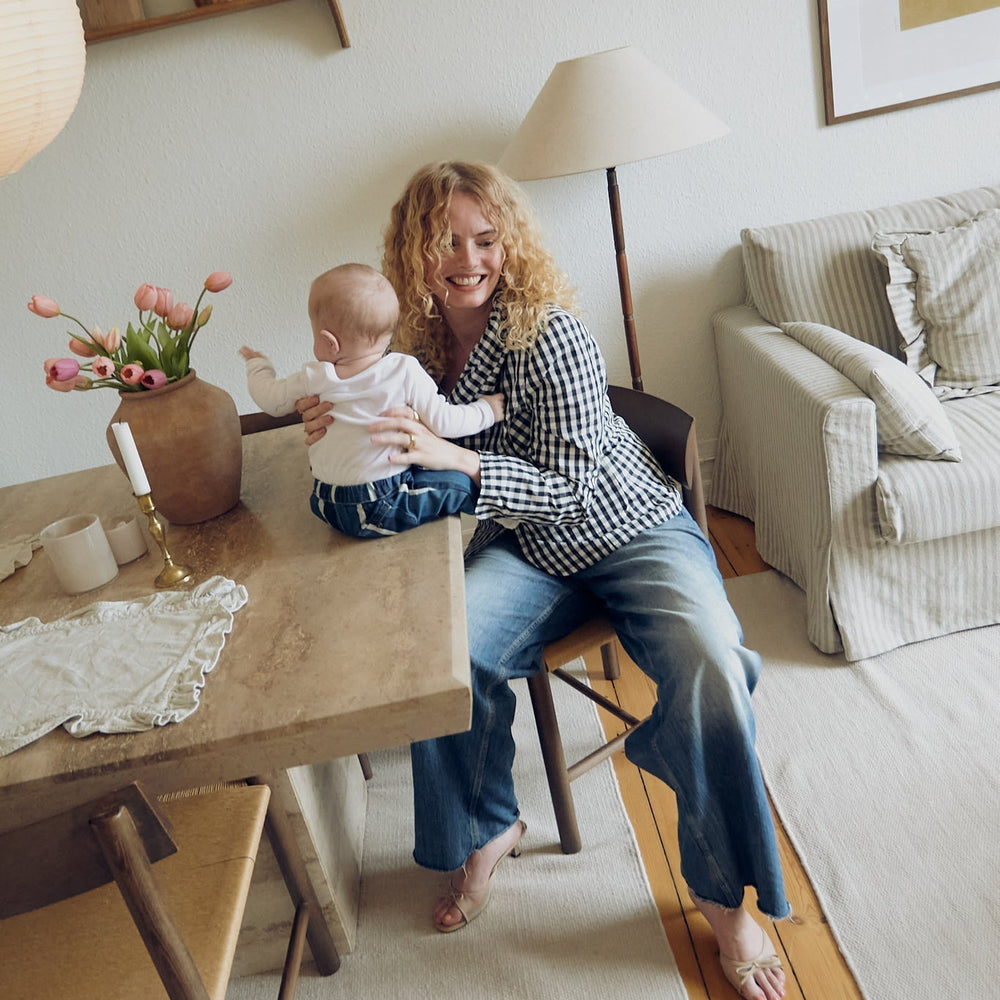
And even though Johanne has spent years lying awake due to fertility treatment, the nights with Roberta are something else entirely.

"I find it easier to be up at night because this has a meaningful cause. This is, after all, a happy thing. I don't think it's difficult to be a mother when you have been through the hard stuff on the other side."

<p>If this is life</p>

If this is life

Johanne and Lukas have six eggs left from the same donor – and with that, the possibility of a biological sibling for Roberta. The very day after the birth, Johanne told Lukas that she wanted another one. But this time, she is approaching it with a different mindset.

"If this is life, then I have everything I could ask for. I don't need to move. I have Magda, I have Lukas, I have Roberta. If it doesn't work out, I still have everything. But if we can have a third, then I would really love that."

To others in fertility treatment, she has one piece of advice that has carried her through: Always have something nice on the calendar.

"I have an embryo transfer then, and if it doesn't work out, then we have something nice on the calendar. A concert, an overnight stay somewhere, a trip to the city. So you have something to look forward to. Because it swallows money, it swallows time, it swallows energy. So you have to fill yourself up with something good. I have never eaten so many croissants and so much sourdough bread."

And then you have to take care of yourself – and each other.

"There comes a point where you give up. And that is also when people say: 'Just keep going, it will work out.' But you really have to take care of yourself and your relationship, because it is all-consuming. There is really so much else that is good in life, I found out. If you see it."

Photo: Cecilia Jørgensen

Art Direction & Text: Laura Gilling Rosenberg