Latest Mom Diary

Mathilde Nauta

“You can love your child more than anything and still find the beginning difficult.”

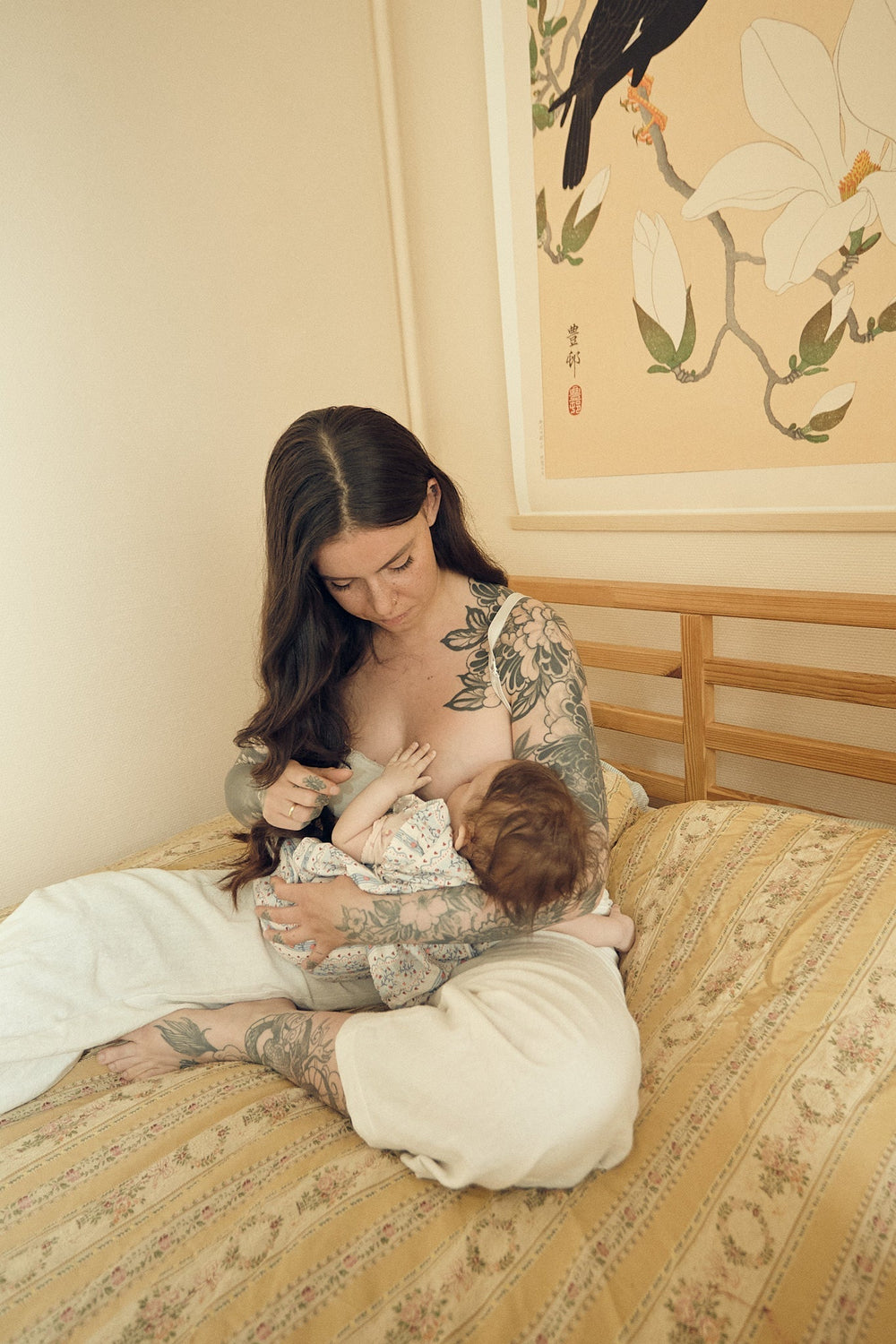
When Mathilde Nauta became a mother to Theo, she was struck by emotions and a reality she could in no way have prepared for. The love was there from the first moment. It had actually been there long before he was in her arms. But amidst the overwhelming love, Mathilde also experienced postpartum issues, extreme sleep deprivation, powerlessness, shame, and a longing for herself, her freedom, and the life she knew before. For Mathilde, the initial period was a difficult balancing act, largely about finding herself in a completely new life – and about the urgent need to find something recognizable when her energy was completely depleted.

June 25, 2026

Latest Mom Diary

Mathilde Nauta

“You can love your child more than anything and still find the beginning difficult.”

June 25, 2026

When Mathilde Nauta became a mother to Theo, she was struck by emotions and a reality she could in no way have prepared for. The love was there from the first moment. It had actually been there long before he was in her arms. But amidst the overwhelming love, Mathilde also experienced postpartum issues, extreme sleep deprivation, powerlessness, shame, and a longing for herself, her freedom, and the life she knew before. For Mathilde, the initial period was a difficult balancing act, largely about finding herself in a completely new life – and about the urgent need to find something recognizable when her energy was completely depleted.
Image 1

From young love to family

Mathilde is 28 years old and lives in Frederiksberg with her boyfriend Lasse and their five-month-old son, Theo. Mathilde and Lasse both come from the area around Næstved and knew each other long before they became a couple.

It was only when they were both single that they started writing to each other, and after 10 years together, the relationship evolved into the family life they have now.

Image 2
<p>A pregnancy filled with strong emotions</p>

A pregnancy filled with strong emotions

Mathilde and Lasse had long talked about having children, but the decision became concrete during a trip to Vietnam and Thailand.

"That's when we were like: Now we're trying."

Mathilde had imagined it would take time to get pregnant. But already on the first attempt, she held a positive test in her hand.

"It happened much faster and took me completely by surprise."

The pregnancy was both beautiful and difficult. The first trimester was especially emotionally tough because her thoughts were consuming. She thought about who she would become as a mother, how her relationships would change, and what life would look like on the other side.

"I didn't know what I was getting into. I just thought: Can I do this? Who will I become? How will my relationships be? There were so many questions."

At the same time, she developed an early and strong bond with Theo.

"I might have cried almost every day about how much I loved Theo, and talked to him in my belly. I'm very much like that – I just bond strongly."

She was excited and imagined life with him. Mathilde is the type who can easily romanticize things, and that is usually one of her strengths. But no matter how much she had looked forward to it, the transition to reality became overwhelming because the first period was marked by extreme sleep deprivation, postpartum complications, and a little Theo who cried a lot.

<p>An expectant but intense birth</p>

An expectant but intense birth

Mathilde gave birth at Herlev Hospital. Leading up to the birth, she was quite sure she wouldn't go into labor on her own, and as her due date came and went, she became both impatient and restless. To create some calm, she made a physical calendar with the date she imagined Theo would arrive – and made lists of cozy and lovely things she could do before then.

"Then I can find some peace in that."

With that peace, her body started working the very next morning. When she arrived at the hospital, it turned out she was 7 centimeters dilated. Still, she was sent home again, as they assessed that the labor wasn't progressing enough yet. On the way home, she had her first real contraction, and shortly after, they had to return.

The labor quickly became intense. Contractions came in quick succession. At the same time, the staff had difficulty getting a proper reading of Theo's heartbeat. It wasn't clear to Mathilde what was happening, and she was physically hard-pressed by the strong contractions and lack of strength.

Theo quickly had electrodes attached, and Mathilde ended up getting through the rest of the birth without pain relief. The pushing phase lasted two hours, and when she was told that the next step was to use a vacuum extractor, she found her last reserves of strength.

"Then I just summon all the strength I have left in my body. I think I practically roar him out."

Theo came into the world, and Mathilde was immensely relieved that he was finally safely in her arms.

<p>When sleep vanished and the body short-circuited</p>

When sleep vanished and the body short-circuited

After the birth, Mathilde, Lasse, and Theo stayed at Herlev Hospital. They were unsure in their new roles and often rang for assistance. Mathilde was particularly troubled by a fear that Theo would stop breathing when he slept.

At the same time, her own body was completely exhausted from the pregnancy and birth. Mathilde suffered from several postpartum complications that drained her both physically and mentally. On top of the pain and exhaustion, she simply couldn't find peace.

"My body was incredibly weak, but I couldn't sleep."

When they returned home, the sleeplessness continued. Over the first five days, Mathilde slept a total of only eight hours.

"I simply couldn't switch off, and I ended up becoming afraid of the dark. I became afraid of the nights."

It quickly developed into a vicious cycle. The severe sleep deprivation, postpartum complications, lack of structure, and feeling of complete loss of control weighed heavily on her. And when Theo cried a lot, without her knowing how to help him, helplessness overwhelmed her.

"I think I had imagined that magical baby bubble time – but that was not at all what I experienced. I was so shocked that I had looked forward to it so much, but that I also felt I was sad."

Instead, she was left with the responsibility for a tiny human, while she herself was completely spent.

"It was just as if I had to be an adult, but what I most needed was actually for someone to take care of me."

<p>Loving Your Child and Missing Yourself - The Need for the Recognizable</p>

Loving Your Child and Missing Yourself - The Need for the Recognizable

For Mathilde, motherhood was a stark contrast to her life before. From one day to the next, everything changed at once: her body, her role, her relationships, and her sense of self. In the midst of it all, she was left with a deep feeling of having to reinvent herself in a completely new life with unfamiliar boundaries.

“From one day to the next, you have to adjust to a whole new life. In every aspect. A new body, a new role, a new relationship with your partner, a new relationship with your group of friends. Everything was new. It's still a process where I have to reconcile everything and figure out who I am now.”

The combination of massive sleep deprivation, physical post-birth discomfort, and constant worry that Theo was so unhappy meant that Mathilde's reserves hit rock bottom. When everything in her new daily life felt chaotic and draining, there arose a huge need to reach for something familiar – small elements that could remind her of her old life. She thought a lot about the time before and missed the feeling of being able to be alone.

Not because her love for Theo was lacking, but because she simply didn't have the energy to prioritize the things that usually recharged her. She had imagined that she would, in a way, get herself back when Theo arrived. Instead, it felt like there was even less space. Today, she sees it as completely natural: that space naturally doesn't really exist in the beginning, where all focus is on being there for your child. But these are feelings you cannot prepare for in advance.

At the same time, it became difficult not to compare herself with others' stories about the first period:

"And that's also the false thing about social media – it looks like many others have energy, and then I've thought: Why don't I? But I just don't at all. Sometimes I can't even handle people visiting because I just feel like I have to survive the day, especially if I haven't slept."

With the longing also came the shame.

"I was incredibly ashamed that sometimes I wanted to escape. Why am I thinking these thoughts? Why am I not just happy? Because it has nothing to do with him or with love."

For Mathilde, it was never about a lack of love for Theo. But precisely because of that, the feelings were difficult for her to vocalize, because she was afraid that they might be misunderstood as if she wasn't happy with the situation.

Image 1

The turning point and "Whatever works, works"

In addition to Mathilde's own exhaustion, Theo cried a lot in the first few months. One evening it became so critical that she and Lasse went to Herlev Hospital urgently after Theo had cried non-stop for ten hours.

"I don't believe that children or babies cry just to cry."

At the hospital, they were told that he was healthy and well, and that he probably had colic. But Mathilde felt that there was something more, and so they continued their search. In North Zealand, they received help and found out that Theo had tension and an asymmetry in his neck, which could affect his stomach and caused him pain.

"We spent almost two months trying to figure out why he cried so much, driving from one place to another. I just wanted to help him."

Image 2

It became an important experience in trusting what she felt as a mother.

"Quite often, I was actually right about what I sensed and felt regarding Theo. But I ended up listening too much to what others were doing, instead of looking at my child and saying: What does he need now? And then trusting that."

Amidst all the difficulties, Mathilde also found small anchor points in everyday life. Not perfect routines, but small things that brought peace: cozy moments, a bit of order around her, and the thought that whatever works, works.

"Sometimes you just have to survive."

Fortunately, Mathilde was not alone. Close friends gave her the necessary care, and her parents, in particular, stepped in. Furthermore, Lasse became her most important anchor, able to keep her spirits up when she couldn't herself.

Image 1

Finding small pieces of yourself again

For Mathilde, it's not about a desperate struggle to return to the person she was before giving birth. It's about building a bridge between the past and the present. She has realized that she needs to be able to feel herself and hold onto something familiar in order to function in her new role.

“For me to be a good mother, I really need to hold onto what I, as a person, enjoy, and what recharges me.”

In the beginning, she felt guilty and selfish when she felt the need to withdraw and have something that was just hers. But today, she is beginning to find peace with her feelings. It’s not selfish – it’s a necessity. Because she is not only a mother; she also needs to find space to just be Mathilde.

Image 2
Image 1

Looking forward to the next chapter

Now that Theo is five months old, Mathilde is truly feeling that things are slowly getting easier – and much more fun. She is settling into her role as a mother and enjoys the longer wake windows where they can experience the world and do things together as a proper family.

 “I dream of us being able to do things together, all three of us – and I dream of a summer house for moments as a family.”

She also looks forward to Lasse going on paternity leave, giving them a few months together as a trio, during which she can prioritize herself more again. Mathilde loves being a mother – and motherhood has taught her to appreciate her time and the small things in life even more than she did before.

Perhaps this is one of the most important realizations in Mathilde's story: That you don't become less of a mother by also needing time for yourself. That true love and exhaustion can coexist. And that the early days don't have to feel magical for everyone:

“You can love your child more than anything and still find the beginning difficult.”

Image 2

Photo: Cecilia Jørgensen

Art Direction & Text: Laura Gilling Rosenberg