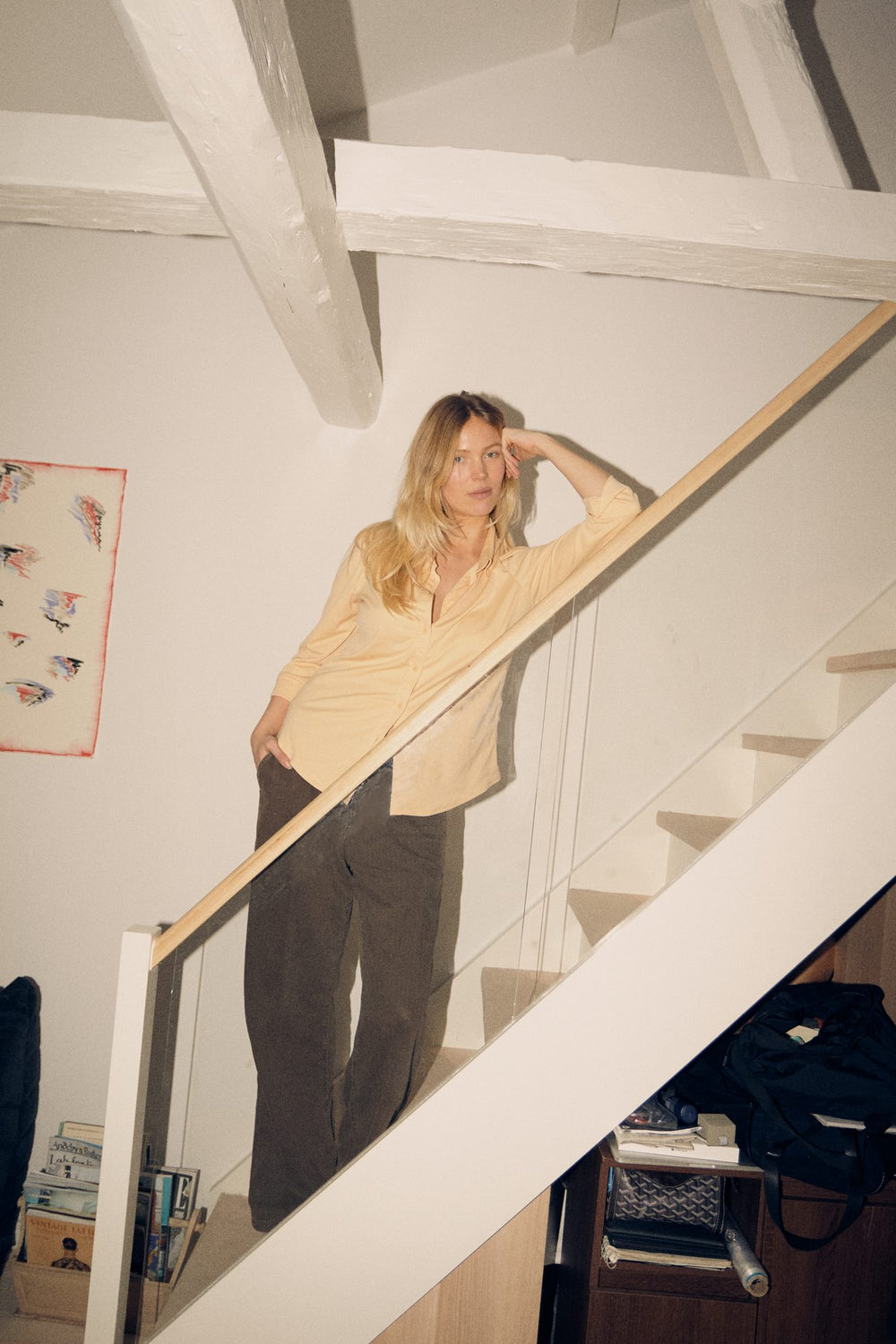
Latest Mom Diary

Tharsiny Thanendran

"I want to feel like myself in my own body again." Thoughts on the post-pregnancy body and the balance between motherhood and identity.

Thas became a mother to Uma – who arrived six weeks early and gave motherhood an intense start. In this Mom Diary, she honestly shares her thoughts on the time before and after, and on the desire to feel at home in her own body again. At the same time, she puts into words something many can recognize: that the love for your child and the desire to find your way back to yourself can indeed coexist.

March 26, 2026

Latest Mom Diary

Tharsiny Thanendran

"I want to feel like myself in my own body again." Thoughts on the post-pregnancy body and the balance between motherhood and identity.

March 26, 2026

Thas became a mother to Uma – who arrived six weeks early and gave motherhood an intense start. In this Mom Diary, she honestly shares her thoughts on the time before and after, and on the desire to feel at home in her own body again. At the same time, she puts into words something many can recognize: that the love for your child and the desire to find your way back to yourself can indeed coexist.
<p>A life that was already good</p>

A life that was already good

"I've actually known Peter for many years," Thas explains. She moved to Copenhagen in 2015 and, unknowingly, rented his apartment through her brother. It wasn't until several years later that they met again at a wedding. There was chemistry, but the timing was off.

"We would meet up about once a year. Something always happened – but never really anything serious."

Until one day.

"We ended up on the same flight by chance. And when we got home, we started dating. And we've been together ever since."

Today, they have been a couple for almost seven years and married since 2023.

They had a life of freedom, spontaneity, and a strong feeling of being exactly where they wanted to be. Therefore, the decision to have children did not stem from a classic longing.

"We had a really great life. We traveled, worked, and spent time with our friends. We actually didn't feel like we were missing anything."

The decision arose more as a quiet curiosity.

"We were kind of like... let's see what happens."

And when she became pregnant, her perspective changed – not because something was missing before, but because something new found its place.

From everyday life to birth in a few hours

The pregnancy, unexpectedly, was uncomplicated – almost so calm that it felt unreal.

"I kept waiting for something to happen – nausea, discomfort – but nothing did."

Perhaps that's why the contrast with the birth was so stark. A perfectly ordinary day – with practical errands and a husband at a bachelor party – suddenly turned into something completely different.

"I come home, and it feels like I'm peeing my pants."

What at first seems harmless turns out to be the beginning of labor. Six weeks before term.

She calls the midwife. "You need to come in now."

Image 1

Peter is at a bachelor party. “He'd had 10 shots,” she laughs.

“And I just said: I think my water broke.”

He immediately gets in a taxi and drives towards Thas, while she quickly packs a bag – without really knowing what she'll actually need. Shortly after, they are sitting together in the taxi on their way to the hospital.

After that, things move quickly. Very quickly.

“From when I was about to paint the kitchen until I gave birth… everything happened so fast that I barely understood what had happened.”

Five hours and 45 minutes later, Uma is born. The pushing stage only lasts 20 minutes. “I didn't get any pain relief. There just wasn't time.”

Uma is born six weeks prematurely and weighs only two kilos. In a few hours, Thas goes from everyday life to motherhood – in an intense transition where the body takes over before the mind can catch up.

Image 2

A start you can't prepare for

Because their daughter was born six weeks prematurely, family life didn't begin at home – but at the hospital. It was a start characterised by monitoring, sounds, and constant attention to the slightest sign.

"It was really intense. You're there with all the other little babies, and everything is flashing and noisy."

She was tiny and needed help with both warmth and food, which created a very special atmosphere around her first period as a mother.

"You're just worried all the time. Whether she's breathing, whether her heart is beating, whether everything is as it should be."

It wasn't the calm start many imagine – but a time where love and worry coexisted.

<p>When everyday life becomes a state of emergency</p><p></p>

When everyday life becomes a state of emergency

When they returned home, the framework changed – but not the intensity.

Days quickly became structured around fixed intervals. Food, sleep, pumping. Repetitions that left little room for anything else.

“I pumped every three hours. I gave tube feeds. You were just in this limbo.”

Time blurred, and it was hard to find a rhythm in something that constantly demanded attention. “There was no flow – just survival.”

But amidst it all, small progress began to make a difference. When their Uma no longer needed tube feeding, it became a clear turning point.

“It was as if we became a normal family. Now it was just us.” A shift where everyday life slowly became recognizable again.

<p>Not losing yourself</p><p></p>

Not losing yourself

Amidst all the newness, it has been crucial for Thas to hold on to who she is – not as a resistance to motherhood, but as a way of being in it.

“I was afraid I would change completely. But I still feel like I am me.”

Life is not the same as before. It is slower, more planned, and requires more considerations. But the content is still recognizable. They still travel, see friends, and prioritize experiences – just at a different pace.

“We do the same things – just slower.”

The family has already traveled to places like New Zealand, Australia, and Singapore, and the desire to experience the world is still part of their shared identity. At the same time, it has required conscious choices to create space for herself in everyday life.

She and Peter have arranged their routines so that she can run several mornings a week before the day begins – a small but important space.

“It has been incredibly important for me to prioritize myself. Otherwise, I think you lose yourself a little.”

And precisely that is the essence for her: to be able to accommodate both parts at once.

“I couldn't imagine her not being here. She's just the icing on the cake.”

<p>The body – and what you don't always say out loud</p>

The body – and what you don't always say out loud

For many, the body after pregnancy is associated with expectations – both internal and external.

“I really wanted to be that 'cool mom' who is just comfortable in her body.”

But reality is rarely that simple. For Thas, it has been about navigating several emotions at once.

“I am proud that my body created a child. It's wild. But I also want to be myself again.”

And it is precisely that she wants to express loudly. That the two things do not exclude each other.

“I can feel that there's a narrative that you just have to embrace everything right after childbirth. And I couldn't. And I actually think that should be okay.”

There can be an expectation that you should love your postpartum body. That you should embrace the change immediately. But it doesn't necessarily feel that way.

“You don't love your child less because you want to go back to what you know. The two things don't necessarily go together.”

A realization that allows for honesty – without shame.

Image 1

A different pace – not a different life

Thas is soon returning to work as a project manager at Novo Nordisk, and maternity leave has changed her perspective on both time and career.

"Before, I used to worry a lot about whether I was shooting myself in the foot by being away for so long. But now I think I'll get there in the end."

Where she used to be preoccupied with pace and progress, she now sees it differently.

"I'll get there. All of it."

Her ambitions are still there, and the desire to work, socialize, and develop has not disappeared.

"I still feel just as adventurous. I still want it all."

Image 2
<p>Finding your own way</p>

Finding your own way

The couple is considering having more children.

"I think we'll have one more. But we'll take it as it comes."

There are many preconceived notions about what motherhood should be like – how one should feel, look, and live their life. But for Thas, it's more about finding her own way through it.

"You can read all the advice in the world – but ultimately, the baby just needs its parents."

And perhaps most importantly:

"It's going to be alright. Even if it feels incredibly hard."

For her, it's crucial that there's room for nuances – even the less talked about ones.

"And it's okay to want your body back. Just as it's also okay not to want it."

Ultimately, it's not about choosing one right way to be a mother. But about making room for everything – for both love and doubt, change and familiarity.

For Thas, it's not a question of either-or, but about finding a balance where she can still be herself – while also being a mother.

Foto: Cecilia Jørgensen

Art Direction & Tekst: Laura Gilling Rosenberg